I will now turn to my favourite reviewing subject: Samurai things!
I realise that this entry will probably seem tedious to many, but it's really something I'm very passionate about, and one of the most interesting things I could think of that I wished to write about that would still be somewhat easy to follow when my joy of sharing information took over. So if you do decide to read it, I hope you will find it as fascinating as I do, or perhaps it's my fascination that is fascinating, but regardless, enjoy the awesome photos.
Sunday, May 31, 2009

Saturday, March 7, 2009
Yoshitoshi's Art in Kagrra,'s PV, "Kotodama"
I'd like to take a moment to write about the most cultural thing I can think of:
Kagrra,.
Well, sort of.
I guess it's no secret that Kagrra, is my favourite band. (Their new album, Shu, comes out April 1! =D) But it is often a very hard decision for me to select just what must be my favourite band and my favourite song and my favourite PV. I see/listen/watch the music I like during most of my day, and new artists and singles and things are being added to the mix by the second. So for me, it is a difficult decision, which I base on the culmination of absolutely everything I am exposed to within the band and their work. I'm rambling... what I mean to say is that, with the style of music, clothing, the message, the imagery, and the dedication of the band, Kagrra, is the band I would have to choose for pretty much every "What is your favourite" question.
You should know that I enjoy learning and studying all types of cultural things from all over the world, running the gamut from history, religion, customs, culture, people, tribes, art, etc. It goes on and on. Naturally, a lot of my interest comes from what I myself have been exposed to by way of my own childhood, education, and thoughts impressed upon me by my mother. I like to research, write, and share with anyone who will listen my thoughts and views and (limited) knowledge on the things around me and the things I am interested in. But if we're being honest here, yeah, I guess a lot of it comes from video games. If you asked me to explain as much as I could about the Three Kingdoms Era of China, about 99.9% of it would be from Dynasty Warriors, probably including quotes from the characters and my own halting descriptions of the awesome awesome (inaccurate) costumes that they wear.
So, when she requested that I make a review of some Kagrra, videos and the subtle cultural and at times religious imagery that they use, I guess I jumped at the chance. Reading back on this post so far, I guess I jumped and fell pretty hard, but the sentiment remains the same that I am now going to start a series (spread out over the course of when I feel like it, so as not to become monotonous and boring, or at least to give me an extra entry when my brain stops working and I go months without updating) of reviewing various aspects of Kagrra, and some information that the casual fan (or even someone who is not yet a fan) may not know. Or at least, to be interesting and expand my repertoire of rock music reviews beyond "xxx can't sing, and the songs are overused pieces of shit, so why is this band so popular?", "xxx sucks now that Bou is gone", or "xxx is wearing a big ugly hat".
So, now that I've been given my mission, obviously I set out right away to procrastinate and not do it.
I decided to start my series of reiews with the ultimate Kagrra, song: Kotodama. Not only was it essentially Kagrra,'s very first song, but it was also the very first PV of theirs I ever saw. It made me a fan, which I will get into later, but first and foremost, it is, to me, the epitome of what Kagrra, represents, and remnants of the message the song gives can be found in every subsequent song or PV if you think about it. So I began to watch it with hopes of reviewing it, and realised that I had my work cut out for me: so much was happening in the PV, so many subtleties and interesting little tidbits I wanted to mention, so many things going on at once, it was as if the very story of the kagura itself was being relayed, and then the arc of Yamato crashed down upon its head, and the whole thing wrought forth some kind of impromptu festival. I'm not kidding, if you try to watch it with a mind to take notes and absorb the happenings, the whole thing becomes a blurred mess of tradition and horror.
Which I guess is a good way to describe Kagrra,, huh?
So anyway, please stay tuned to the next post, in which I will explain the history of Kagrra,/kagura and the meaning of the song/PV, as well as interesting facts about rock music, Shinto, and Japanese folktales/horror, for in this post, we need to get all of our peripherals clear so that we may view the PV with a focused eye.
So now, I shall relay the tale of how I was first exposed to Kagrra,, the intricacies of art, and just why Kagrra, is allowed to have their very own genre of music.
Kagrra,.
Well, sort of.
I guess it's no secret that Kagrra, is my favourite band. (Their new album, Shu, comes out April 1! =D) But it is often a very hard decision for me to select just what must be my favourite band and my favourite song and my favourite PV. I see/listen/watch the music I like during most of my day, and new artists and singles and things are being added to the mix by the second. So for me, it is a difficult decision, which I base on the culmination of absolutely everything I am exposed to within the band and their work. I'm rambling... what I mean to say is that, with the style of music, clothing, the message, the imagery, and the dedication of the band, Kagrra, is the band I would have to choose for pretty much every "What is your favourite" question.
You should know that I enjoy learning and studying all types of cultural things from all over the world, running the gamut from history, religion, customs, culture, people, tribes, art, etc. It goes on and on. Naturally, a lot of my interest comes from what I myself have been exposed to by way of my own childhood, education, and thoughts impressed upon me by my mother. I like to research, write, and share with anyone who will listen my thoughts and views and (limited) knowledge on the things around me and the things I am interested in. But if we're being honest here, yeah, I guess a lot of it comes from video games. If you asked me to explain as much as I could about the Three Kingdoms Era of China, about 99.9% of it would be from Dynasty Warriors, probably including quotes from the characters and my own halting descriptions of the awesome awesome (inaccurate) costumes that they wear.
So, when she requested that I make a review of some Kagrra, videos and the subtle cultural and at times religious imagery that they use, I guess I jumped at the chance. Reading back on this post so far, I guess I jumped and fell pretty hard, but the sentiment remains the same that I am now going to start a series (spread out over the course of when I feel like it, so as not to become monotonous and boring, or at least to give me an extra entry when my brain stops working and I go months without updating) of reviewing various aspects of Kagrra, and some information that the casual fan (or even someone who is not yet a fan) may not know. Or at least, to be interesting and expand my repertoire of rock music reviews beyond "xxx can't sing, and the songs are overused pieces of shit, so why is this band so popular?", "xxx sucks now that Bou is gone", or "xxx is wearing a big ugly hat".
So, now that I've been given my mission, obviously I set out right away to procrastinate and not do it.
I decided to start my series of reiews with the ultimate Kagrra, song: Kotodama. Not only was it essentially Kagrra,'s very first song, but it was also the very first PV of theirs I ever saw. It made me a fan, which I will get into later, but first and foremost, it is, to me, the epitome of what Kagrra, represents, and remnants of the message the song gives can be found in every subsequent song or PV if you think about it. So I began to watch it with hopes of reviewing it, and realised that I had my work cut out for me: so much was happening in the PV, so many subtleties and interesting little tidbits I wanted to mention, so many things going on at once, it was as if the very story of the kagura itself was being relayed, and then the arc of Yamato crashed down upon its head, and the whole thing wrought forth some kind of impromptu festival. I'm not kidding, if you try to watch it with a mind to take notes and absorb the happenings, the whole thing becomes a blurred mess of tradition and horror.
Which I guess is a good way to describe Kagrra,, huh?
So anyway, please stay tuned to the next post, in which I will explain the history of Kagrra,/kagura and the meaning of the song/PV, as well as interesting facts about rock music, Shinto, and Japanese folktales/horror, for in this post, we need to get all of our peripherals clear so that we may view the PV with a focused eye.
So now, I shall relay the tale of how I was first exposed to Kagrra,, the intricacies of art, and just why Kagrra, is allowed to have their very own genre of music.
Sunday, February 8, 2009
Lantern Festival
Hello, everybody. As you may or may not know, the Chinese Lantern Festival (Koshōgatsu), is a celebration that takes place just after the Chinese New Year, bringing those festivities to a close. It also happens to be tomorrow. The festival involves, oddly enough, lanterns, and the carrying of them to shrines. The style and size of the lantern you carry will naturally vary, many people just before this time of year will take to making and setting out eye-catching lanterns. I have seen a very old gentleman who had, in his youth, learned to make lanterns, and a few weeks before every Lantern Festival, he would set his work aside and dedicate himself to fashioning many lanterns in the shape of animals and hang them outside his home, showing the trade to children and more often than not, having the majority of them bought up in preparation for the festivities. I know it all sounds like the plot to some trite and very precious children's movie about growing up and respecting your elders, but guys like this really do exist and are just cool.
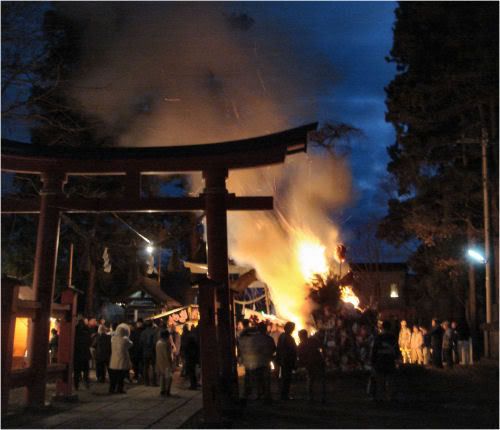
So when you have your lantern, you and your family will set out, and head to any and all shrines within walking distance that catch your fancy. Depending on your location, there may be many stands set up with snacks to buy and games to play, and many lanterns will have little puzzles on them to be solved. It's all very traditional and really exciting. The evening will end with a bonfire at your shrine, lit between a torii and symbolizing the destruction of all bad luck. More often than not, you will also partake in some superstitious activity to rid yourself of bad luck and bring good luck in the New Year.
The point of this festival is to bring families together to face the New Year, and to connect with them as well as with nature and religion, and to generally have a good time and fill the next year of your life with "light". Aha!
This practice is celebrated the world over, really, and the activities will vary, but the general mood and actions are the same. You have your family, you have your lantern, you eat some snacks, you have fun. In America, I know that there are superstitions to eat black eyed peas and spinich on New Year, though I'm not entirely sure why. I think the spinach is supposed to represent money, and wealth to come in the next year. Can anybody fill me in? Anyway, since the Lantern Festival isn't exactly a national holiday here in America, and there isn't a Shinto shrine within walking distance of where I live, my Lantern Festival will be considerably less interesting.
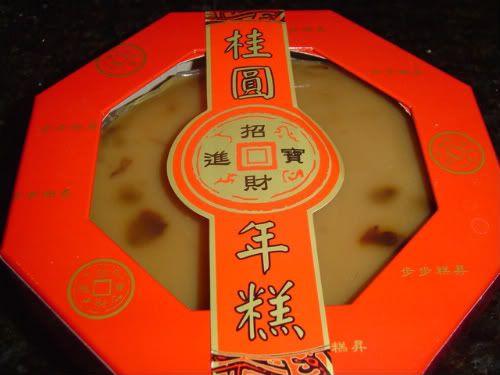
I still have this cake left over from New Year, my family will eat that.
And since it also is a full moon, of course, my mother has decided that we will have a traditional moon-viewing festival, which is basically an excuse to drink good sake and dress in wafuku. Despite doing this every day, and the actual festival being held in August, each month when she gets bored, my mother declares it moon-viewing day, and when it's a full moon we drink and tell ghost stories. Even though this entry is making me sound like a stock character from xxxHOLiC, I will press onward and share with you all some more interesting facts about, what else, lanterns.
So when you have your lantern, you and your family will set out, and head to any and all shrines within walking distance that catch your fancy. Depending on your location, there may be many stands set up with snacks to buy and games to play, and many lanterns will have little puzzles on them to be solved. It's all very traditional and really exciting. The evening will end with a bonfire at your shrine, lit between a torii and symbolizing the destruction of all bad luck. More often than not, you will also partake in some superstitious activity to rid yourself of bad luck and bring good luck in the New Year.
The point of this festival is to bring families together to face the New Year, and to connect with them as well as with nature and religion, and to generally have a good time and fill the next year of your life with "light". Aha!
This practice is celebrated the world over, really, and the activities will vary, but the general mood and actions are the same. You have your family, you have your lantern, you eat some snacks, you have fun. In America, I know that there are superstitions to eat black eyed peas and spinich on New Year, though I'm not entirely sure why. I think the spinach is supposed to represent money, and wealth to come in the next year. Can anybody fill me in? Anyway, since the Lantern Festival isn't exactly a national holiday here in America, and there isn't a Shinto shrine within walking distance of where I live, my Lantern Festival will be considerably less interesting.
I still have this cake left over from New Year, my family will eat that.
And since it also is a full moon, of course, my mother has decided that we will have a traditional moon-viewing festival, which is basically an excuse to drink good sake and dress in wafuku. Despite doing this every day, and the actual festival being held in August, each month when she gets bored, my mother declares it moon-viewing day, and when it's a full moon we drink and tell ghost stories. Even though this entry is making me sound like a stock character from xxxHOLiC, I will press onward and share with you all some more interesting facts about, what else, lanterns.
Subscribe to:
Posts (Atom)